
IEEE 1815.2 Standard (Previously known as MESA-DER)
The IEEE Std 1815.2 standard maps the utility SCADA protocol IEEE 1815 (DNP3) to the IEC 61850-7-420 DER semantic model (data objects), thus creating an interoperable profile of DER functions, monitored information, and control commands.
IEEE Std 1815.2-2025 Semantic Model using DNP3
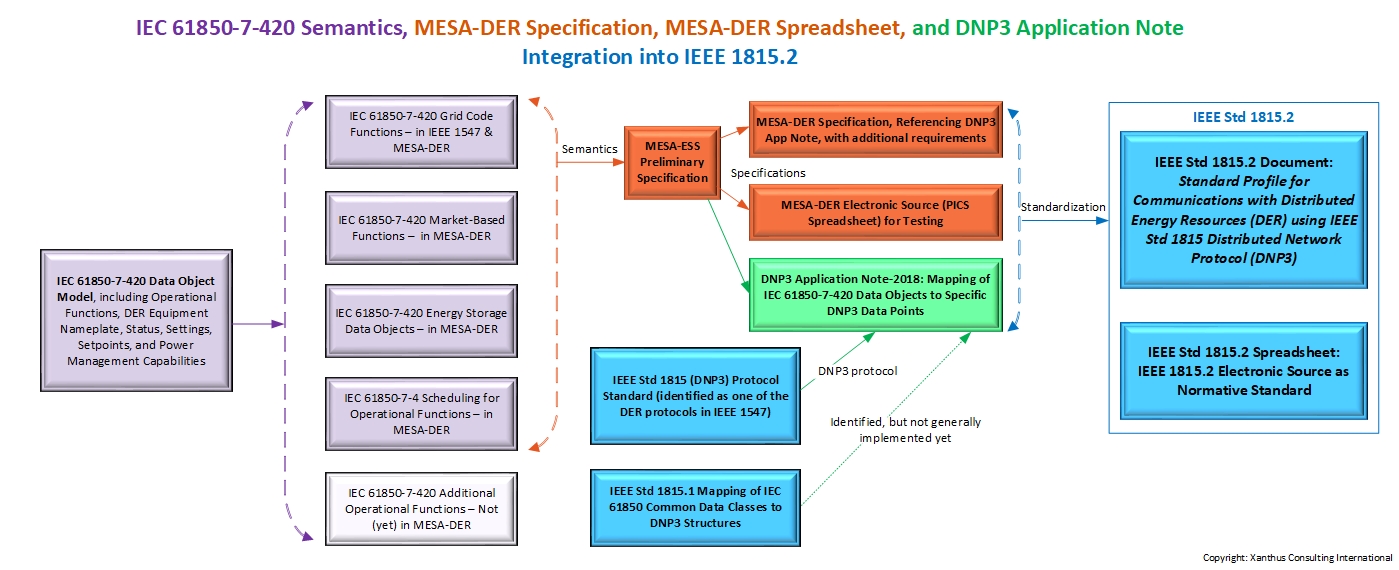
MESA-DER has become IEEE 1815.2! MESA-DER has been a de facto standard for several years and provides interoperable communications for Distributed Energy Resources (DER) with a special focus on utility-scale energy storage system (ESS) and modern grid functionality such as microgrids and Inverter-Based Resources (IBR). It is structured with two international standards: IEC 61850 and IEEE 1815 (DNP3) by mapping the IEC 61850-7-420 semantic data model standard for DER to the widely-used IEEE 1815 (DNP3) protocol standard, thus creating an interoperable profile of DER functions, monitored information, and control commands. IEEE 1815.2 supports all the IEEE 1547 and California Rule 21 DER functions as well as additional market-based DER functions for utility grid safe, reliable, and efficient operations. In addition, IEEE 1815.2 covers the data exchange requirements for ESS configuration management, including ESS role-based access control (RBAC) for different ESS operational states. The IEEE 1815.2 semantic model using DNP3 is one of the protocol options in IEEE 1547 revision and 1547.1a.
This multi-year process is shown in the diagram:
Basic Functions
- Monitoring Function: The DER provides status, measurements, and other requested data
- Connect/Disconnect Function: Connect or disconnect (cease to energize) the DER from the grid at its ECP
Emergency Modes
- High/Low Voltage Ride-Through Mode: The DER rides through temporary fluctuations in voltage at the PCC
- High/Low Frequency Ride-Through Mode: The DER rides through temporary fluctuations in frequency at the PCC
- Dynamic Reactive Current Support Mode: The DER reacts against rapid voltage changes to provide dynamic system stabilization
- Frequency-Watt Emergency Mode: The DER responds to large frequency excursions during H/LFRT events at a referenced ECP by changing its charging or discharging rate
Active Power Modes
- Active Power Charge/Discharge Mode: Set the DER to charge or discharge real power at the referenced ECP
- Limit Active l Power Discharging or Charging Mode: Limits the discharging or charging level of the DER based on the referenced ECP
- Load Following (Peak Power Limiting) Mode: The discharging real power output of the DER follows the load at the Referenced ECP if it starts to exceed a target power level.
- Generation Following Mode: The discharging or charging of the DER follows the generation at the referenced ECP if it starts to exceed a target power level.
- Active Power Smoothing Mode: The DER produces or absorbs real power in order to smooth the changes in the power level of the referenced ECP.
- Volt-Watt Mode: The DER responds to changes in the voltage at the referenced ECP by changing its charging or discharging rate
- Automatic Generation Control (AGC) Mode: The DER responds to raise and lower power level requests to provide frequency regulation support
- Coordinated Charge/Discharge Mode: The DER determines when to charge so long as it meets its State of Charge level obligation by the Charge-By date and time in the most cost-effective manner or based on owner preferences
- Frequency-Watt Smoothing Mode: The DER responds to changes in frequency at the referenced ECP by changing its charging or discharging rate based on frequency deviations from nominal, as a means for countering those frequency deviations
Reactive Power Modes
- Fixed Power Factor Mode: The DER power factor is set to a fixed value.
- Volt-Var Control Mode: The DER responds to changes in voltage at the referenced ECP by supplying or absorbing vars in order to maintain the desired voltage level
- Watt-Power Factor Mode: The DER responds to changes in power at the referenced ECP by changing its power factor
- Power Factor Correction Mode: The DER supplies or absorbs VArs to hold the power factor constant at the referenced ECP.
Additional Capabilities
- Scheduling of Power Settings and Modes: The DER follows the schedule which consists of a time offset (specified as a number of seconds) from the start of the schedule and is associated with a power system setting, the enabling/disabling of an operating mode, and a price signal.
- Establish Ramp Rates: In addition to the default ramp rate, the DER may support multiple ramp rates that reflect different conditions.
- Soft-Start Reconnection: Use ramp rate or random time within window when reconnecting
- Permit reconnection: Utility or other authority permits reconnection, but reconnection may or may not start at that time
- Microgrid separation control: Process for normal separation, emergency separation, and reconnection (in development)
- Provide Black Start Capability: Ability to start without grid power and the ability to add significant load in segmented groups (in development)
- Provide Backup Power: Ability to provide power to local loads when not connected to the grid
Detailed Equipment Information
- DER unit status, alarms, and measurements
- Inverter status, alarms, and measurements
- Battery cells status, alarms, and measurements
- Metering status, alarms, and measurements
