MESA Guidelines and Examples of Using IEEE 1815.2
MESA’s IEEE 1815.2 Guidelines provide guidance and examples of how to use IEEE 1815.2 for achieving your goals. Do you need to Limit Active Power Export? How do you respond to Set Active Power at the PCC? Do you want to engage in Energy Arbitrage while still meeting other requirements? How can Schedules be used? What about bidding into the provision of ancillary services for the ISA while still meeting the IEEE 1547-2018 requirements?
An overview of MESA’s IEEE 1815.2 Guidelines can be downloaded here. The complete IEEE 1815.2 Guidelines are available to MESA members.
Why MESA?

Grid-connected DER and energy storage systems benefit the electric power industry and all electric users, from the smallest residential customers to the largest industrial plants.

Communications are critical for managing grid-connected DER, and standardized communication specifications are therefore key to the deployment of large numbers of DER and ESS across all grids worldwide.

MESA standardized communication specifications clear barriers to this critical need for interoperability.

Through standardization of communication specifications, MESA accelerates interoperability, scalability, safety, quality, availability, and affordability in distributed energy resources (DER), in particular energy storage systems (ESS) and their components.
Example Guidelines for Set Active Power Use Case
Set Active Power (aka Charge/Discharge) is a very basic function for Energy Storage Systems (ESSs) (or any other DER) in which the ESS is requested to charge or discharge at a specific rate or at a specific percentage of maximum discharge (WMax), either through direct commands or via a schedule for specific times and durations.
Variations of this function could include the DSO issuing a command for requiring a specific active power value or a minimum active power value to be exported at the PCC. The Generating Facilities could determine what active power levels to set the different DER units, or could have the ESS “follow” the PV systems to compensate for PV variations so that this requirement is still met at the PCC.
Example Guidelines of Limit Active Power Export/Import Use Case
Based on near-real-time power assessments and perhaps the Spot Market, the DSO issues an Export Limit and/or an Import Limit schedule or command for the Reference Point of Applicability (RPA), containing start day and time, duration, and limit value in watts, to one or more DER units or to a DER or IBR plant or microgrid. Start day and time could be immediate or in the future. Once the command has expired or been canceled, the DER units, plants, or microgrids return to their normal limits, including any previously scheduled limits. If both Export Limits and Import Limits are set, the limits form the complete range of export and import permitted at the RPA.
Example of Energy Arbitrage Use Case
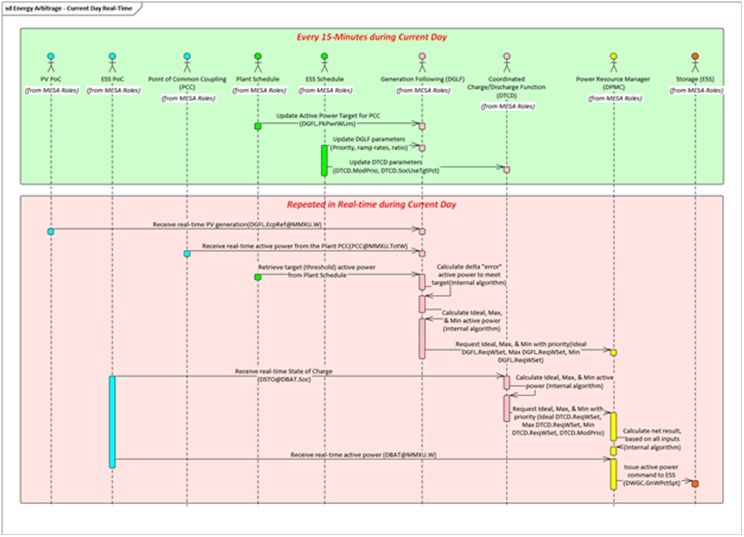
Energy arbitrage is the shifting of energy production from lower price to higher priced times, and the corresponding shifting of energy use from higher price to lower priced times.
In wholesale energy markets enabled by energy storage devices, energy arbitrage refers to purchase of energy when the prices are low and resale of purchased energy when the prices are high. In the distribution system, energy arbitrage is exercised by the utility through tariffs that depend on the time of day and encourage consumers to shift their energy use from higher priced times to lower priced times.
It is therefore important to state that the Energy Arbitrage Use Case described in this document refers more to the use of energy storage devices to shift energy from one time of day to another and is thought to be the primary use case for energy storage devices especially when combined with a renewable energy source. The most common approach is to set schedules to Set Active Power for Importing and/or Exporting, but to possibly add Set Active Power Limit commands if there are either mandatory limits (with high priority) or economically derived limits (with more flexible priorities).